How Long Does Strep Throat Last? A Pediatrician Explains
By Ragini Miryala, MD, Pediatrician
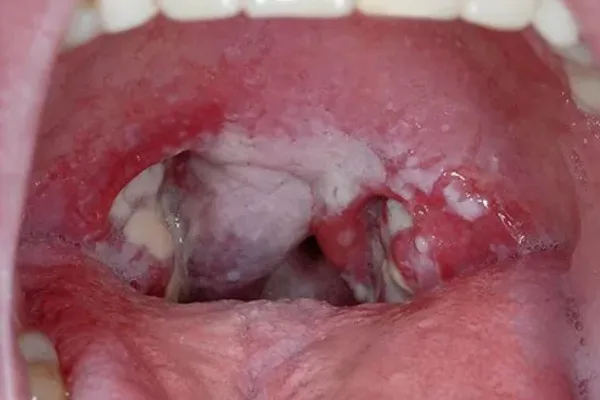
It's a little after six on a weeknight and you're standing in the hallway outside her room with your hand on your kid's forehead. She's hot. She's been crying that it hurts to swallow. She won't even take a sip of water. The pediatrician's office closed an hour ago. And you're doing the math in your head. Is this a school day tomorrow, do we go in, is this the thing everybody's been passing around Clear Lake?
Medical Disclaimer:
This article is for general education only. It is not a substitute for an in-person evaluation, diagnosis, or treatment from your child's clinician. If your child is having trouble breathing or swallowing, call 911 or go to the nearest emergency room.
I've been practicing pediatrics here in the Bay Area for more than twenty years, and I want to say this first: you are not overreacting. Sore throats are one of the most common reasons families come see us, and worrying about your child when she can't swallow is not anxiety. It's parenting.
So let's answer the question you actually came here for.
How long does strep throat last? The short version
Here's the timeline I give parents in the room, before we get into anything else:
Untreated, strep throat symptoms usually run about 7 to 10 days. Most kids get better on their own, but "on their own" carries risks we don't want to take.
With the right antibiotic, most kids feel meaningfully better within 24 to 48 hours. Fever comes down, the throat stops feeling like broken glass, they start eating again.
Contagious window: a child is generally no longer contagious after about 12 to 24 hours on an appropriate antibiotic, as long as they're also fever-free without fever medicine.
The full antibiotic course still has to be finished, usually 10 days, even after your child seems totally fine. This part matters more than almost anything else in this article.
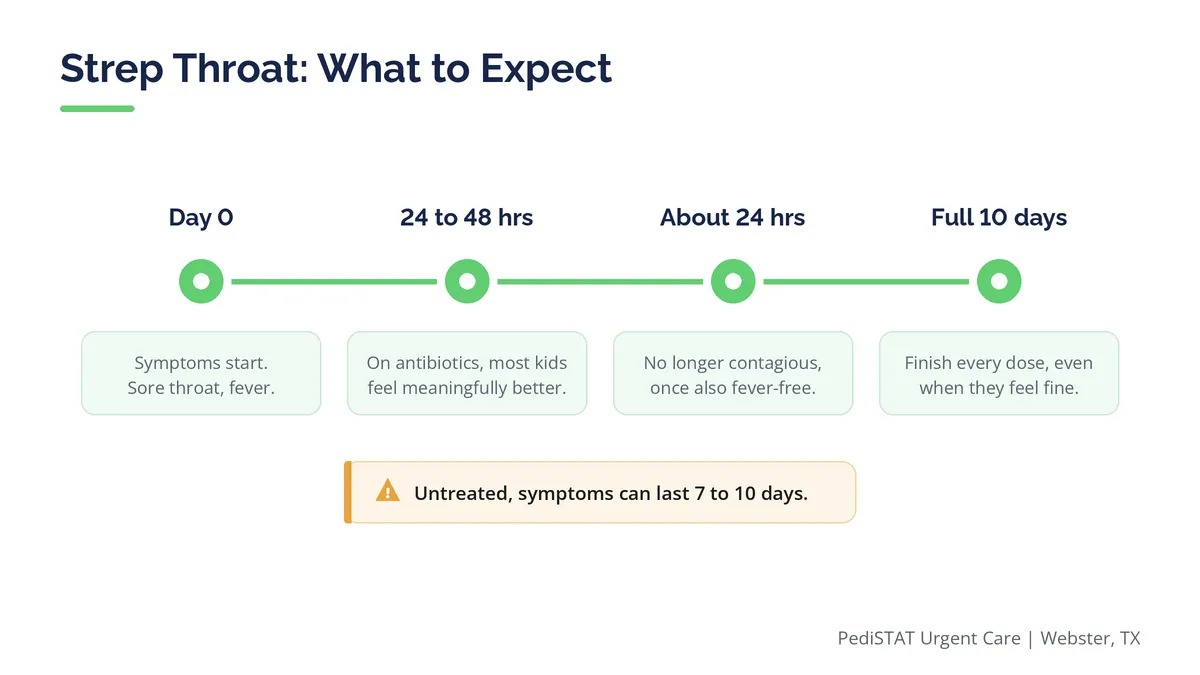
Strep throat recovery timeline: what to expect without treatment, what changes once antibiotics start, and when the contagious window closes.
That's the answer. Now let me explain the parts that trip families up.
How long is strep contagious, really?
This is the second question I get, usually within about ten seconds of the first one. Parents want to know when it's safe to hug the baby again, when the older sibling can stop sleeping on the couch, when everybody can go back to normal.
Before treatment, a child with strep can be contagious for two to three weeks, even if the symptoms fade. That's a long stretch, and it's one of the quieter reasons we treat strep instead of waiting it out. Antibiotics collapse that window down to roughly a day.
But I want to be careful here, because I see this misunderstanding constantly: 12 to 24 hours on antibiotics is not the same as "one dose." If your child got a dose at bedtime and still has a 101 fever at breakfast, they are not ready to go anywhere. The rule I use with my families is simple: a full day of antibiotics and a full day fever-free without Tylenol or Motrin in their system. Both. Not one.
And in a house with siblings, keep the toothbrushes separate, don't share cups or water bottles, and wash hands more than feels reasonable. Strep spreads through droplets: coughing, sneezing, sharing a straw at the dinner table.
How long will my child actually feel awful?
The honest answer is that the worst of it is usually the first two or three days, and the sharpest misery is the swallowing.
Strep pain is different from the scratchy throat of a cold. Kids describe it as sharp, or like glass, or like it's stuck. Little ones can't say that, so instead they stop drinking, they drool a bit, they refuse the foods they normally love, they get clingy and hot and miserable. I've had four-year-olds in my exam room who wouldn't touch a popsicle, and when a child turns down a popsicle, that tells me something.
Once antibiotics start working, the turnaround is often dramatic. Parents call me the next afternoon a little stunned that their kid is running around the living room. That's typical. It's also exactly the moment the antibiotic bottle starts getting forgotten on the counter.
If you would rather have someone look at that throat today than keep guessing at home, we are open and glad to see you.
or call (832) 215-8884
Why you have to finish the antibiotics even when they seem fine
If you take one thing from this article beyond the timeline, take this one.
Strep is caused by a bacteria called Streptococcus pyogenes, or group A strep. Antibiotics knock the symptoms down fast, but clearing the bacteria completely takes the whole course. When a course gets stopped early, we open the door to complications that are rare but genuinely serious:
Rheumatic fever, an inflammatory reaction that can damage the heart valves. It's uncommon in the U.S. now, and the main reason it's uncommon is that we treat strep properly.
Kidney inflammation (post-streptococcal glomerulonephritis).
Abscesses in and around the tonsils.
Symptoms returning, sometimes worse.
I've had this conversation with families for two decades, and I've never once regretted being repetitive about it. Ten days. Set a phone alarm. Keep the bottle somewhere you can't miss it. Next to the coffee maker works better than the medicine cabinet.
If your child has an allergic reaction, or the medicine keeps coming back up, don't just stop. Call us. There are alternatives.
Is it strep or just a virus? Here's what I look for
Most sore throats in children are viral, not strep. Viruses don't need antibiotics and won't respond to them. So how do we tell?
There are patterns. They're helpful, and they are not proof.
What you're seeing | Leans strep | Leans viral |
|---|---|---|
How it started | Sudden, fine at lunch and miserable by dinner | Gradual, builds over a day or two |
Cough | Usually none | Common |
Runny nose, congestion | Usually none | Very common |
Fever | Common, often higher | Possible, often milder |
Neck glands | Swollen and tender to touch | Mild or normal |
Throat appearance | Very red, sometimes white patches or tiny red dots on the roof of the mouth | Red, often with mouth sores |
Other symptoms | Headache, stomachache, sometimes vomiting | Hoarse voice, pink eye, body aches |
Typical age | 5 to 15 years | Any age |
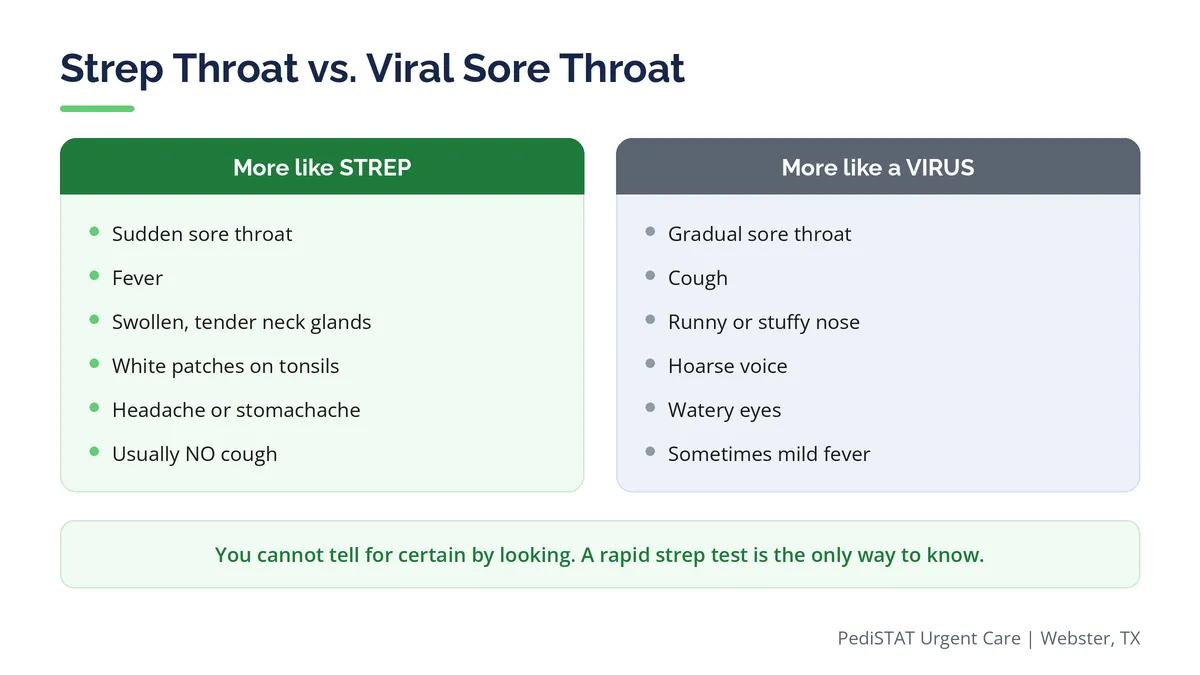
A side by side look at the patterns that lean strep and the patterns that lean viral, and why a test is what settles it.
Now the part I say out loud in every one of these visits: I cannot reliably tell strep from a virus just by looking in your child's throat. Neither can any pediatrician, no matter how many throats we've seen. Some of the angriest-looking throats I've examined were viral. Some of the mild-looking ones came back positive. That's not a failure of experience. It's just biology, and it's exactly why we test.
The other misconception I gently correct a few times a week: a cough and a runny nose alongside a sore throat usually point away from strep. Not always. But often enough that it's worth knowing.
What the rapid strep test is actually like
Parents brace for this one, and kids brace harder. It's easier than you think.
We use a long, soft swab (think of a very skinny cotton swab) and touch it briefly to the back of the throat and each tonsil. It takes a couple of seconds. It's not painful, though it does trigger a gag for some kids, and a few will tear up. I usually have a parent hold the child on their lap, chest to chest, and it's over before anybody's braced for it.
A rapid strep test gives results in about 10 to 15 minutes. Positive means strep, and we start treatment that visit.
A negative rapid test is where the nuance lives. The rapid test is very good at ruling strep in, but it can miss some cases. So when the rapid is negative and your child's story still sounds like strep to me, we send a throat culture. It's the same swab, grown in the lab over 24 to 48 hours to catch what the quick test missed. If that culture turns positive, we call you and start antibiotics then. Starting treatment a day or two in still protects against the complications that matter. You have not lost your window.
We run rapid strep testing onsite here, so most families walk out knowing.
A swab takes seconds, so if you would rather leave today with an answer than a maybe, we are here seven days a week.
or call (832) 215-8884
Making your child comfortable at home
While the antibiotic does its work, comfort care is the whole job:
Fluids, in whatever form they'll accept. Water, milk, diluted juice, electrolyte drinks, broth. Small sips beat big gulps. With strep, hydration is the thing I watch most closely, because a throat this painful makes kids stop drinking.
Cold and soft wins. Popsicles, ice cream, yogurt, smoothies, applesauce, pudding, cold noodles. Skip anything sharp, crunchy, acidic, or spicy. Orange juice on a strep throat is a rough experience.
Fever and pain medicine. Acetaminophen or ibuprofen, dosed by your child's weight, not their age. Confirm the exact dose with your pediatrician or pharmacist, because weight-based dosing is easy to get wrong from memory, and I'd always rather you call.
Never give aspirin to a child or teenager. Aspirin is linked to Reye's syndrome, a rare but very serious condition affecting the brain and liver. Check the labels on any combination cold remedy in your cabinet.
Salt-water gargle for older kids who can do it without swallowing. Use about a half teaspoon of salt in a warm cup of water. Soothing, low-tech, genuinely helps.
Rest, and a humidifier if the air's dry.
New toothbrush after a couple of days on antibiotics. Small thing, easy to forget.
When I want to see your child right away
Trust yourself here. If your gut says something is off, that's a good enough reason. But specifically, come in, or go to the ER, for any of these:
Trouble breathing, or noisy breathing
Trouble swallowing, or drooling because swallowing hurts too much in a child old enough not to drool
Unable to keep fluids down, or no wet diaper or urination in 8 or more hours
A stiff neck, severe neck swelling, or inability to open the mouth fully
Fever that won't come down with medicine, or fever lasting more than 48 hours after starting antibiotics
A sandpapery red rash (this can mean scarlet fever, which is still strep and still treatable, but I want to see it)
Signs of dehydration: no tears, dry mouth, sunken eyes, unusual sleepiness
Getting worse after starting antibiotics instead of better
That last one deserves its own line. Improvement should be the direction of travel by day two. If it isn't, don't wait it out.
When can they go back to school or daycare?
Texas schools and daycares generally follow the same standard I use: your child can return 24 hours after starting an appropriate antibiotic, provided they're fever-free for 24 hours without fever-reducing medicine and feeling well enough to get through a school day.
For most families that means a positive test on a Monday afternoon and back in class Wednesday morning. Some campuses in Webster, League City, and Friendswood ask for a clearance note, and we're happy to write one at your visit.
And if your child is technically cleared but still looks wiped out? One more day at home has never hurt a child. You know your kid.
We're right here in Webster when you need us
Sore throats don't wait for Monday morning. That's the whole reason we built PediSTAT Urgent Care the way we did: Child & Teen Urgent Care, pediatric-first, with providers who spend all day taking care of kids. Adults in the family are welcome too.
We have rapid strep testing onsite, plus onsite X-ray and lab, so you're not driving somewhere else for answers. We're open seven days a week including weekends, waits are short, and we serve families across Webster, League City, Friendswood, Seabrook, Dickinson, and La Porte. We accept TRICARE, UnitedHealthcare, Blue Cross Blue Shield, Aetna, Cigna, Humana, and Curative.
If you're searching for pediatric urgent care near me on a weeknight after the office closes, or on a Saturday, with a kid who won't swallow, here's where to find us:
PediSTAT Urgent Care
205 E Medical Center Blvd, Webster, TX 77598
Hours
Monday to Friday, 9:00 AM to 8:00 PM
Saturday and Sunday, 10:00 AM to 6:00 PM
Or call (832) 215-8884
Book your visit online
Learn more about our pediatric urgent care services, or come see us for a same-day walk-in visit.
Bring your worried self and your miserable kid. We'll swab, we'll know in fifteen minutes, and you'll go home with a plan instead of a question.
Medically reviewed by Ragini Miryala, MD. Last reviewed: September 13, 2026.
This article is intended for general patient education and does not constitute medical advice, diagnosis, or treatment. Every child is different, so please consult your pediatrician or come see us for guidance specific to your child. In an emergency, call 911.