

Sports Physical in Webster, TX: What to Expect and Bring
By Ragini Miryala, MD, Pediatrician
It's a Sunday night in late August. Out of a backpack that's been by the door since May comes a folded form with a coffee ring on it. Tryouts are Monday. It needs a doctor's signature. And somewhere in the house is a fourteen-year-old who just realized the same thing you did.
Medical Disclaimer:
This article is general education, not medical advice about your specific child. Please talk with your child's pediatrician, or come see us, about your child's individual situation.
If that's you tonight, take a breath. A sports physical is a quick, straightforward visit, honestly the happiest appointment I do all week, because the child in front of me isn't sick. They're about to go play something. Every August I see a version of your family, and I've never once thought less of a parent for it.
I've practiced pediatrics here in the Bay Area for more than twenty years. Let me walk you through what this visit is, what I check and why, and what to put in your bag before you head out the door.
What is a sports physical, exactly?
The formal name is a pre-participation physical evaluation, or PPE. Most people just say sports physical or school physical, and that's fine. It's the same thing.
Its job is narrow and specific: to make sure it's safe for your child to play their sport. I'm looking for anything that could put them at risk during hard exertion: an old injury that never fully healed, or a heart or breathing issue that hasn't shown itself yet at rest.
Here's the part I want to say clearly, because it's the most common misunderstanding I run into: a sports physical is not a substitute for a well-child checkup. A well-child visit is the bigger, longer conversation: growth over time, vaccines, vision and hearing, school, sleep, mood, nutrition, all of it. The sports physical is a focused safety clearance. Your child needs both. If it's been more than a year since that full annual visit, please get it back on the calendar.
Sports physical requirements in Texas: the short version
In Texas, students participating in school athletics through the UIL (University Interscholastic League) are required to have a pre-participation physical examination. Schools use a standard UIL Pre-Participation Physical Evaluation form, which includes a medical history section that a parent or guardian and the student both complete and sign, plus the exam portion the examining provider fills out.
One honest caveat, meant practically rather than as fine print: UIL forms and school requirements get updated periodically, and individual districts set their own deadlines. So before your appointment, check your school's athletics page or call the athletic trainer and confirm two things: which form version they want for this school year, and when it's due. The campuses around us don't all run the same calendar. Bring the form your school gives you and we'll work from that.
If you would rather get that form signed today than chase it all week, we have room for your athlete.
or call (832) 215-8884
What actually happens in the room?
It's shorter and calmer than most families expect. Here's the flow.
We start with the history, the paperwork you filled out at home. Then we do the hands-on exam. For most healthy kids, the whole visit runs about 20 to 30 minutes, and walk-in or same-day is often very doable, especially outside the after-school rush.
What I check | Why it matters |
|---|---|
Height and weight | Tracks growth patterns; sudden changes in either direction are worth a conversation |
Vital signs and blood pressure | Elevated blood pressure in a teen isn't rare, and it's better found here than on a field |
Vision screen | Athletes need to see the ball. Also catches kids quietly squinting through school |
Heart (listening carefully, sitting and standing) | Murmurs, rhythm, anything that changes with position |
Lungs and breathing | Wheeze, asthma control, exercise-triggered symptoms |
Abdomen | Organ size and tenderness, which matters for contact sports |
Skin | Rashes and skin infections that spread in locker rooms and on wrestling mats |
Joints, muscles, flexibility | Old ankles, sore knees, shoulders, tight hamstrings, one side weaker than the other |
Posture and spine | Curvature and alignment, especially during growth spurts |
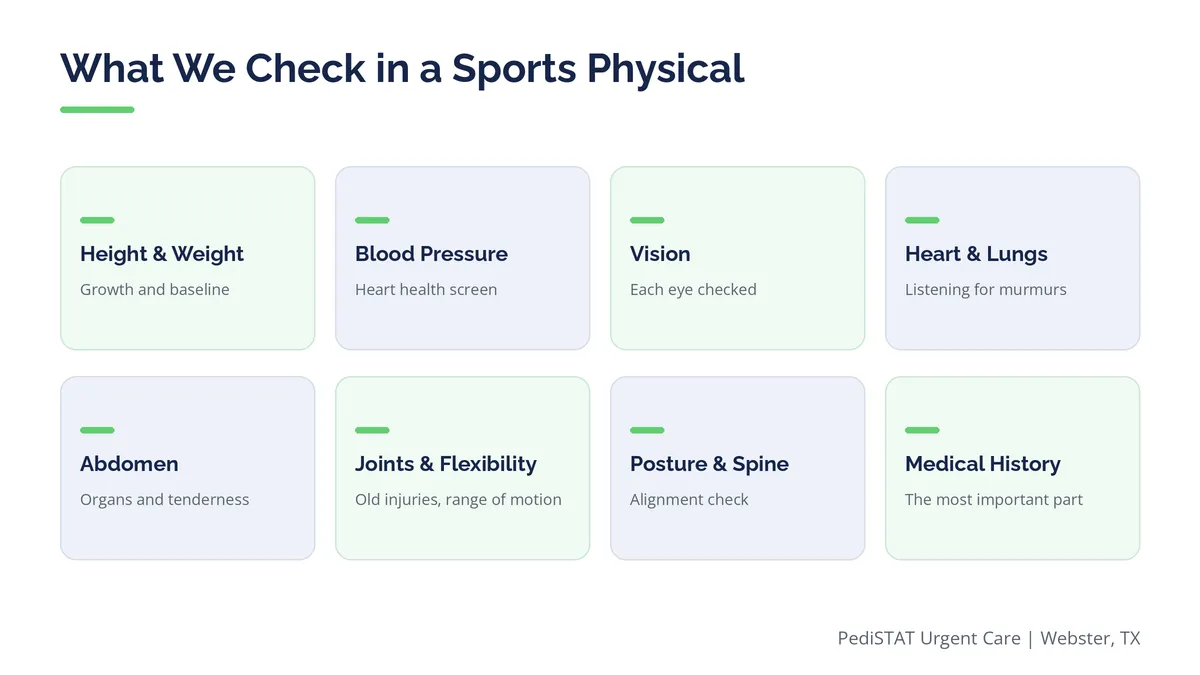
A quick look at each part of the sports physical exam and the reason it is on the list.
I'll usually have a teen walk a few steps, squat, hop on one foot, reach overhead. It looks a little silly in a small room. It tells me a lot.
For the nervous teenager reading over a parent's shoulder
I see you every August, and I know the worry underneath the eye-roll: what if she finds something and I can't play?
So here's what I tell you in the room. No blood draw. No shots unless you're due for one and we talk about it first. Nothing uncomfortable, and you keep your clothes on. If there's something you'd rather tell me without your parent in the room, say so. That's normal, and we can make it happen. And if I want a second look at something, that isn't me taking your season away. It's me making sure you get the whole season instead of half of one.
Why the history section matters as much as the exam
If you take one thing from this article, take this one.
The paperwork you fill out at your kitchen table catches more than my stethoscope does. That's not modesty, it's just how these things work. A healthy fifteen-year-old's heart can sound completely normal on the exam table while the history quietly tells me something important.
So take the extra ten minutes and answer honestly. The questions I care about most:
Any family history of sudden cardiac death, unexplained death before age 50, or heart conditions in close relatives
Ever fainted, gotten dizzy, or passed out during or right after exercise
Chest pain or unusual shortness of breath with exertion
Racing or skipping heartbeats
Any concussion or head injury, even one that seemed minor at the time
Asthma, or coughing and wheezing during exercise
Prior injuries: sprains, fractures, anything that needed a brace, PT, or time out of play
All current medications and supplements, including anything bought over the counter
Parents sometimes hesitate on that concussion question because they worry it'll get their kid benched. Please don't. Knowing helps me protect your athlete. Not knowing is the only version of this that's actually risky.
And the fainting question deserves its own note. When a teen passes out during a workout, or a relative died young and unexplained, those are the details that occasionally make me pause, order an EKG, or send a family to a pediatric cardiologist for one more look. In twenty years I've done that a handful of times. Every one of those was worth the whole month of forms.
What to bring
Tape this to the fridge:
The school or UIL form, with the history section completed and signed by both parent/guardian and student
Insurance card and a photo ID
Glasses or contacts. Actually wear them or bring them
A list of all medications, doses included
The inhaler, if your child has asthma
Any specialist notes, imaging, or injury records from the past year
Braces, orthotics, or supports your child uses to play
Your child's immunization record, if you have it handy
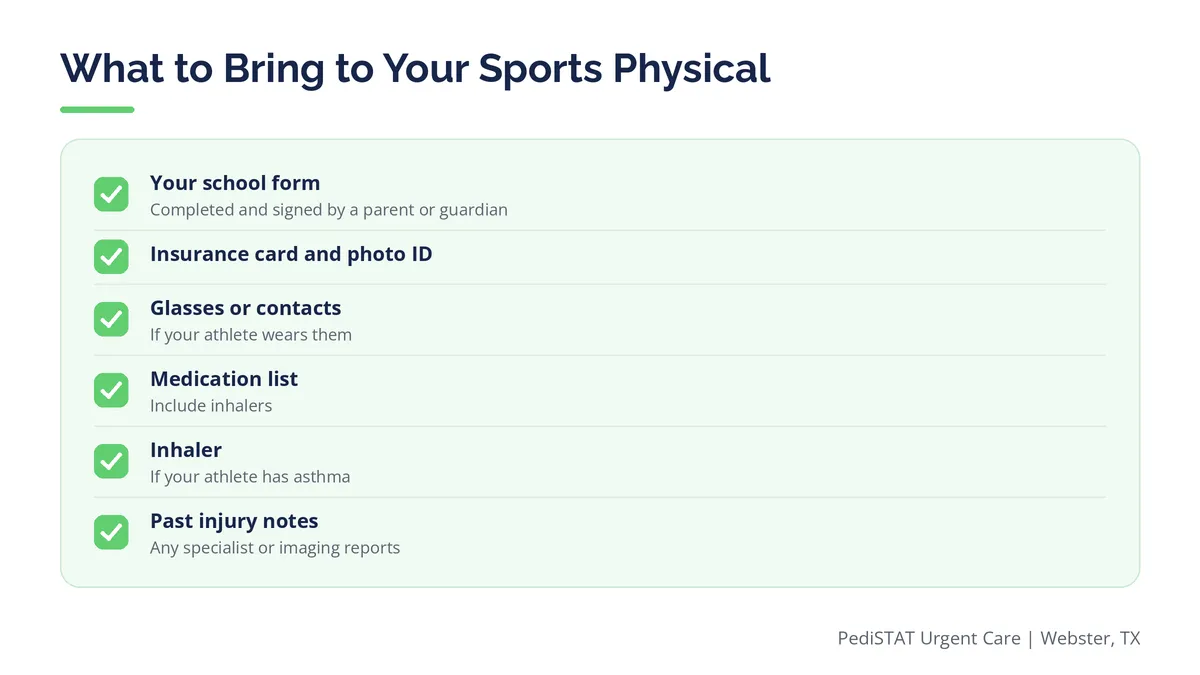
A checklist of the paperwork, cards, and gear to pack before a sports physical appointment.
The signature line is the one that trips families up most. An unsigned history section means a second trip, and nobody wants that on a Monday.
Walk in whenever it suits you, or pick a time now so your athlete is cleared well before tryouts.
or call (832) 215-8884
What "cleared" means, and what a flag really means
There are three ways this visit typically ends.
Cleared. The most common outcome by a wide margin. Signature, form, go play.
Cleared with recommendations. Also common. An asthma action plan, an inhaler refill, hamstring stretches for a tight-hipped runner, an ankle brace, a plan for hydration in Texas August heat. Your child plays. We just add something to help them play better.
Needs a closer look before clearance. The uncommon one, and the one families dread, so let me be direct. A flag almost never means "your child can't play." It usually means one more piece of information: an EKG, a visit with a cardiologist or orthopedist, better asthma control before the season ramps up. Most of these kids end up on the field. We're just taking the safe route there.
I can't promise any particular child will be cleared, and I won't pretend otherwise. What I can promise is that nobody in my exam room gets news without a plan attached to it.
Get ahead of the rush
Late August into September is our busiest stretch for sports and school physicals, and it's simple math. Every campus in the area sets deadlines within the same few weeks. Families searching school physical near me the night before a deadline usually still get taken care of. But coming earlier in the week, or earlier in the day, means a shorter wait and more room to sort out anything that needs a second look before tryouts.
If your child plays a spring sport too, ask us whether one exam covers the school year for your district. Sometimes it does.
Come see us in Webster
At PediSTAT Urgent Care (Child & Teen Urgent Care), we're pediatrician-led, which means the person examining your athlete takes care of kids all day, every day. We have onsite X-ray and lab if an old injury needs a closer look. We're open seven days a week including weekends, waits are short, and walk-ins are welcome. Adults in the family are welcome too.
We see families from Webster, League City, Friendswood, Seabrook, Dickinson, and La Porte, and we accept TRICARE, UnitedHealthcare, Blue Cross Blue Shield, Aetna, Cigna, Humana, and Curative.
PediSTAT Urgent Care
205 E Medical Center Blvd, Webster, TX 77598
Hours
Monday to Friday, 9:00 AM to 8:00 PM
Saturday and Sunday, 10:00 AM to 6:00 PM
Or call (832) 215-8884
Book online here, or just stop in for a same-day walk-in visit.
Bring the crumpled form. Bring the nervous kid. We'll get you sorted, and your athlete will be at practice where they want to be.
Medically reviewed by Ragini Miryala, MD. Last reviewed: September 9, 2026.
This article is for general patient education and does not replace an in-person evaluation, diagnosis, or treatment. It does not establish a physician-patient relationship, and no clearance outcome is guaranteed. Athletic participation requirements are set by UIL and by individual schools and districts and may change, so please confirm current forms and deadlines with your child's school. If you are worried about a medical emergency, call 911.