

How long does an ear infection last?
By Ragini Miryala, MD, Pediatrician
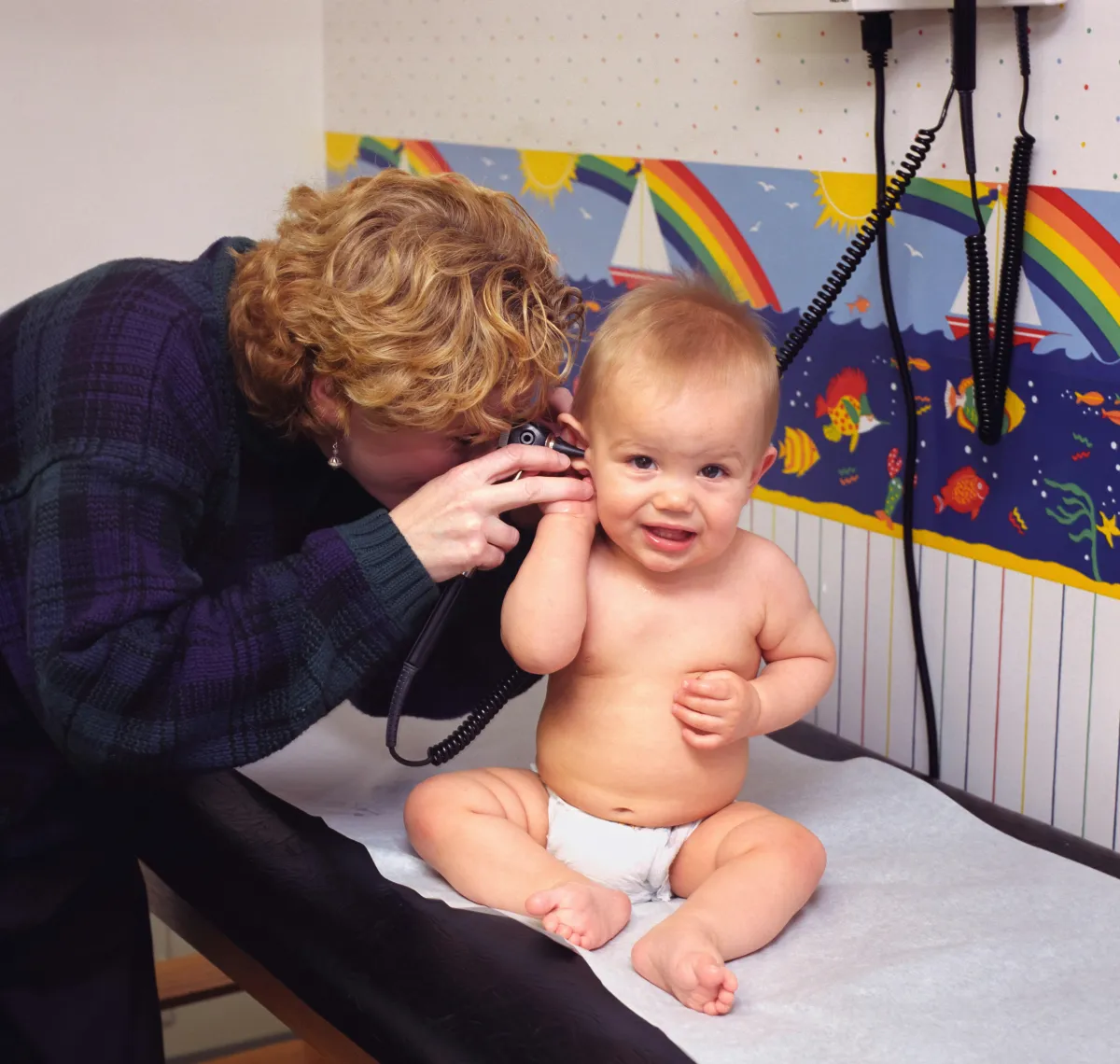
You were up half the night. You tried the rocking, the water cup, the second blanket, the singing. Your toddler kept pulling at one ear and crying in a way you haven't heard before, that sharp, urgent, nothing-is-helping cry. And somewhere between the fourth lap around the living room and the sunrise, you started Googling: how long does an ear infection last? Now it's morning, you're running on nothing, and you're watching the clock waiting for somewhere to open.
Medical Disclaimer:
The information here is general education, not medical advice for your specific child. Please talk with your child's pediatrician or come see us about your child's individual situation.
I've been a pediatrician for more than twenty years, and I promise you, that question is the one I get most. So let me answer it plainly before anything else.
For a typical middle-ear infection, the worst of the pain usually starts easing within 24 to 48 hours, and many uncomplicated infections clear up on their own within about three days to a week. The part that surprises parents: fluid can sit behind the eardrum for weeks, sometimes two or three months, after the infection itself is gone. That lingering fluid is common, it can muffle your child's hearing for a while, and it's worth a recheck. But it usually isn't a sign that something went wrong.
Take a breath. You're not being dramatic. Ear pain is genuinely one of the most painful things little kids experience, and you are right to take it seriously.
What's actually happening in there
The medical name is acute otitis media. "Otitis" means inflammation of the ear, and "media" means the middle ear, the little air-filled space behind the eardrum. The eardrum itself is the tympanic membrane, the thin, normally pearly-gray disc I'm looking at with my otoscope. When it's infected, it can look red, bulging, and angry, and it hurts because there's pressure pushing against it.
That trapped fluid is called an effusion. Even after the germs are cleared, the effusion can hang around like a puddle that takes a while to drain.
Why little kids get these and adults mostly don't
Every child has a eustachian tube running from the middle ear to the back of the throat. Its job is to drain fluid and equalize pressure. In young children, that tube is short, narrow, and nearly horizontal, so it drains poorly and clogs easily. As kids grow, the tube lengthens and tilts downward, and ear infections usually become much less frequent.
This is also why so many ear infections in toddlers show up three or four days into a cold. The cold causes swelling, the tube stops draining, fluid backs up, bacteria or viruses move in. Nothing you did caused it. I say that in the exam room several times a week, because parents so often walk in apologizing.
How long will my child be in pain?
Here's the honest timeline I give families, with the caveat that every child is a little different:
First 24 hours: Usually the roughest. Pain is often worse lying flat and worse at night. Fever is common.
24 to 48 hours: Most children turn a corner. Less crying, better sleep, appetite starting to come back.
Day 3 to day 7: The infection itself typically resolves in uncomplicated cases.
Weeks 2 through 8-12: Fluid may still be sitting behind the eardrum. Your child feels fine and acts fine, but may say things sound "far away" or ask you to repeat yourself. This is the phase that gets missed.
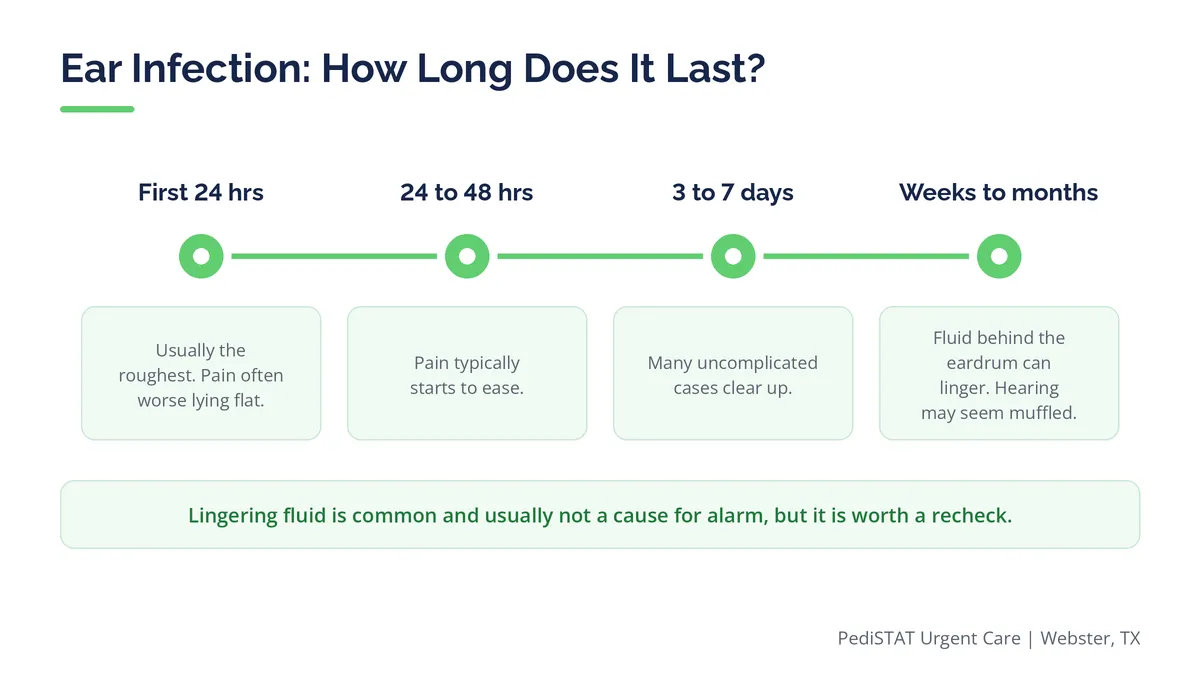
A day by day view of ear infection pain, when most children turn a corner, and how long fluid can linger behind the eardrum.
If your child isn't clearly improving by 48 to 72 hours, that's not a "wait it out longer" moment. That's a "let's take another look" moment.
If you would rather have someone look in that ear today than watch the clock at home, we are open and glad to see you.
or call (832) 215-8884
Wait, do we even need antibiotics?
This is the misconception I gently correct more than any other: not every ear infection needs an antibiotic prescription the same day.
Many ear infections are viral, and a meaningful number of bacterial ones resolve without antibiotics. For older children with mild symptoms, pediatricians often recommend a watchful waiting period of 48 to 72 hours with excellent pain control, sometimes with a prescription in hand to fill only if things don't improve.
Antibiotics are more clearly indicated when a child is an infant or young toddler, when pain is severe, when fever is high, when both ears are involved, or when there's drainage from the ear.
I want to be very clear about this: that's a decision to make together with your clinician, not a rule for you to apply on your own at home. Your child's age, their exam, their history, how sick they look. All of it matters. When we choose watchful waiting in my office, I always tell parents exactly what "getting worse" looks like and exactly when to call me. Nobody gets sent home to guess.
Good ear infection treatment for kids starts with pain control regardless of whether an antibiotic is part of the plan. Pain relief is not optional. It's the treatment.
What it looks like when your child can't tell you
Older kids will point and say "my ear hurts." Babies and toddlers can't, so we read behavior.
Age | What you may notice |
|---|---|
Under 12 months | Inconsolable crying, pulling or batting at the ear, refusing the bottle or breast (sucking increases pressure and hurts), fever, waking repeatedly, not settling when laid flat |
1 to 3 years | Ear tugging, sudden clinginess or meltdowns unlike them, poor sleep, eating less, fever, unsteadiness, fluid draining from the ear |
4 years and up | Says the ear hurts or feels "full," turns up the TV, says "what?" a lot, headache, dizziness, fever, drainage |
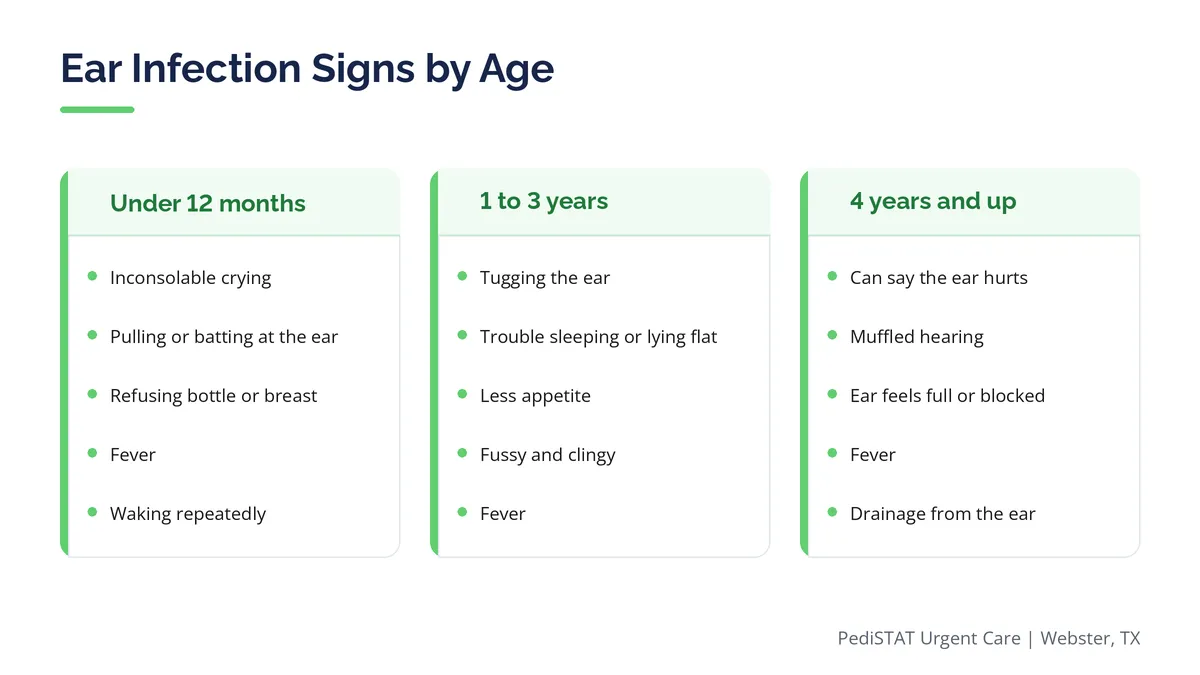
Ear infection signs grouped by age, for the years before a child can tell you what hurts.
One note that catches parents off guard: if you see fluid or pus drain from the ear and your child suddenly seems better, that often means the eardrum released some pressure. It usually heals well, but please have it looked at rather than assuming it's resolved.
What actually helps at home tonight
Weight-based acetaminophen or ibuprofen. This is the single most useful thing you can do. Dose by your child's current weight, not their age, and confirm the amount with your pediatrician or pharmacist. Ibuprofen isn't for babies under 6 months.
Never aspirin for children or teens. It's linked to Reye's syndrome, a rare but serious condition affecting the brain and liver.
Keep them upright. Lying flat increases pressure and pain. Elevating the head of the crib mattress or letting an older child sleep propped on pillows can buy you both a few hours of sleep.
A warm compress against the outside of the ear for a few minutes often soothes.
Fluids, and go easy on expectations. Less eating for a day or two is normal. Wet diapers and hydration matter more.
Nothing in the ear canal. No olive oil, no garlic drops, no leftover drops from a sibling, not without a clinician's OK. If the eardrum is perforated or there's drainage, putting something in there can genuinely cause harm.
You are welcome to come in today if a second set of eyes on that ear would help you rest easier tonight.
or call (832) 215-8884
When I want to see your child
Come in, or head to an emergency room if it's severe, for any of these:
Any infant under 6 months with a fever or suspected ear infection
High fever, or a child who seems unusually lethargic or hard to rouse
Severe pain that isn't touched by appropriate medication
Swelling, redness, or tenderness behind the ear, or an ear that looks pushed outward
Stiff neck, severe headache, or a child who just looks very unwell to you
Pus, blood, or fluid draining from the ear
Symptoms worsening, or not improving after 48 to 72 hours
Hearing that still seems off weeks after the infection cleared
Repeated infections. Several in a year is when we start talking about a referral to an ENT specialist and whether ear tubes make sense
That last one deserves a word. Tubes aren't a failure or a last resort. For kids caught in a cycle of infections or persistent fluid affecting hearing and speech, they can be a real relief. If we get there, we'll talk it through carefully.
One quick thing: swimmer's ear is different
Along the Bay Area, with our pools and our long summers, I see a lot of otitis externa, or swimmer's ear. That's an infection of the outer ear canal, not the middle ear. The tell: it hurts noticeably more when you tug the earlobe or press the little flap in front of the ear. It's usually treated with prescription ear drops rather than oral antibiotics, and it's a different problem with a different fix. Worth an exam to sort out which one you're dealing with.
If today is the day, we're here
You don't have to wait until Monday, and you don't have to decide on your own whether this is "bad enough."
At PediSTAT Urgent Care (Child & Teen Urgent Care) in Webster, we're pediatrician-led, which means the person looking in your child's ear does this all day, every day. We're open 7 days a week including weekends, we keep wait times short, and we have onsite X-ray, lab, and rapid testing if your child's symptoms point somewhere else. Adults are welcome too, because ear pain has a way of running through a whole household.
If you've been searching for pediatric urgent care near me in Webster, League City, Friendswood, Seabrook, Dickinson, or La Porte, we're at 205 E Medical Center Blvd. Learn more about our pediatric urgent care services, or grab a same-day walk-in visit when you need one.
Call us at (832) 215-8884 or book online here. We accept TRICARE, UnitedHealthcare, Blue Cross Blue Shield, Aetna, Cigna, Humana, and Curative.
PediSTAT Urgent Care
205 E Medical Center Blvd, Webster, TX 77598
Hours
Monday to Friday, 9:00 AM to 8:00 PM
Saturday and Sunday, 10:00 AM to 6:00 PM
Or call (832) 215-8884
Bring your child in. Let us take a look. You've done the hard part already. You noticed, and you paid attention.
Medically reviewed by Ragini Miryala, MD. Last reviewed: September 11, 2026.
This article is for general educational purposes and does not replace an in-person evaluation. It is not a diagnosis and does not establish a physician-patient relationship. If your child is having difficulty breathing, is unresponsive or difficult to wake, or you are worried about a medical emergency, call 911 or go to the nearest emergency department.