
Ear Infection vs Teething: How to Tell the Difference and What to Expect at Your Child's Visit
By Ragini Miryala, MD, Pediatrician

It's 2 a.m. Your baby is crying, rubbing one ear, and chewing on anything in reach. Is it a new tooth? Or an ear infection? If you've found yourself searching ear infection vs teething in the dark, you're not alone. It's one of the most common questions pediatric providers hear from moms in Webster, Clear Lake, and League City.
Medical Disclaimer:
This content is for educational purposes only and does not constitute formal medical advice, diagnosis, or treatment. Always consult a qualified healthcare provider regarding specific medical conditions.
Here's why it's so confusing. Both can make a little one fussy. Both can cause ear pulling. Both tend to show up between 6 months and 2 years of age. But they are very different problems, and they call for very different responses.
An ear infection is a true infection behind the eardrum. It's also incredibly common. According to the National Institute on Deafness and Other Communication Disorders (NIDCD), 5 out of 6 children will have at least one ear infection by their third birthday, and ear infections are the top reason parents bring a child to the doctor. Teething, on the other hand, is a normal part of growing up. It can be uncomfortable, but it does not cause fever or make a child seriously sick.
This guide covers the signs that set the two apart, the red flags that need care right away, and exactly what happens during an ear check at our clinic. By the end, you'll know what to watch for and when to bring your child in.
Key Takeaways
Fever points away from teething. The American Academy of Pediatrics (AAP) is clear: teething does not cause fever, diarrhea, or a runny nose. A temperature of 100.4°F or higher means something else is going on, and an ear infection is a common cause.
Only an ear exam can confirm an ear infection. Ear pulling alone isn't proof. A provider needs to look at the eardrum with an otoscope to know for sure.
Know your next step. Ear pain with fever, pain lasting more than a day, or night waking after a cold all call for a same-day visit. Babies under 3 months with any fever of 100.4°F or higher need care right away.
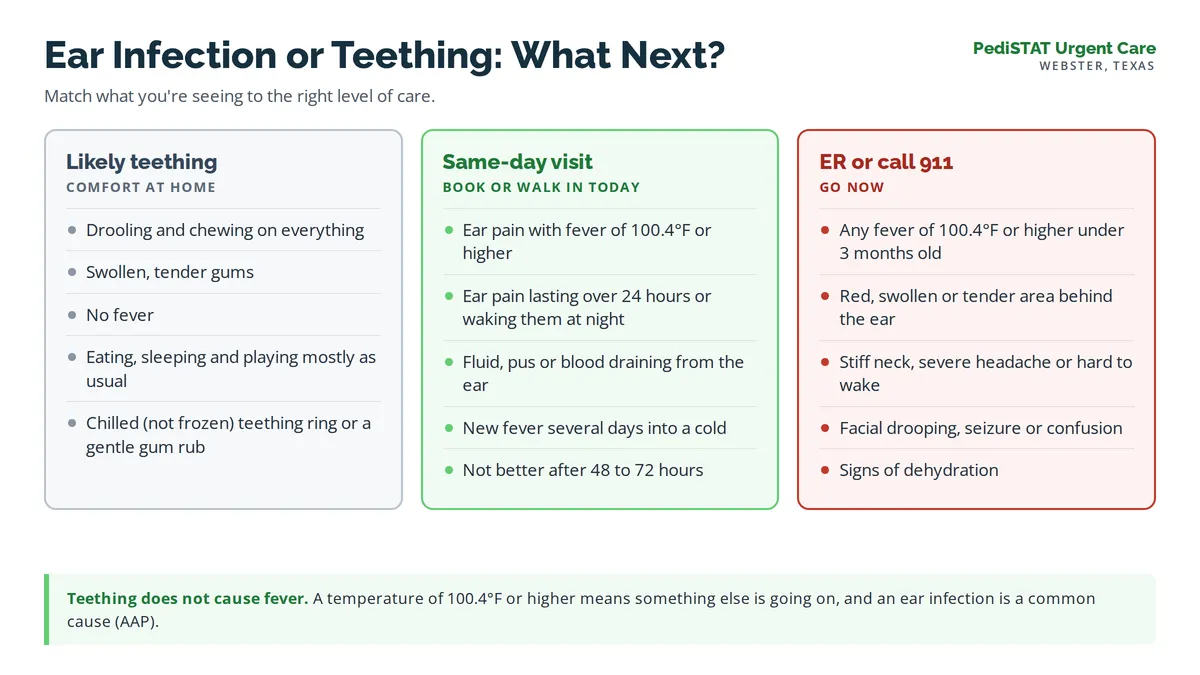
When to watch at home, when to book a same-day visit, and when to go straight to the ER.
Understanding Ear Infections: Causes and Common Symptoms
Most childhood ear infections are acute otitis media (AOM), an infection of the middle ear. The middle ear is a small, air-filled space behind the eardrum. It connects to the back of the throat through a tiny channel called the eustachian tube.
In adults, that tube slopes downward and drains well. In young children, it is shorter, narrower, and more level. So when your child catches a cold, the flu, or RSV, the tube swells and gets blocked. Fluid gets trapped behind the eardrum. Germs that were already in the nose and throat move in and multiply. Pressure builds, the eardrum bulges, and that pressure is what causes the pain.
That's why ear infections so often show up a few days into a cold. It's also why they spike during fall and winter virus season, and why kids in daycare get them more often. They are simply exposed to more germs.
Two other ear problems are worth knowing about:
Otitis media with effusion (OME): Fluid behind the eardrum without an active infection. It often lingers after an ear infection clears. It usually isn't painful, but it can muffle hearing for a while.
Swimmer's ear (otitis externa): An infection of the outer ear canal, not the middle ear. It's common in summer around Bay Area pools and Gulf Coast beaches. A key clue: it hurts when you gently tug the outer ear or press the small flap in front of the ear canal.
Primary Signs and Symptoms
These are the classic signs that point toward a middle ear infection:
Ear pain (otalgia): Older kids will tell you their ear hurts. The pain is often sharp or throbbing and worse at night.
Fever: A temperature of 100.4°F (38°C) or higher is common and can run higher in toddlers.
Fussiness and crying: More than usual, hard to soothe, and often worse when lying down.
Trouble sleeping: Lying flat increases pressure in the middle ear. Many kids wake up crying or refuse to settle.
Ear drainage (otorrhea): Yellow, cloudy, or bloody fluid from the ear canal can mean the eardrum has a small tear from the pressure. The pain often eases once it drains, but your child still needs to be checked.
Tugging, pulling, or rubbing the ear: Common, but not reliable on its own. More on that in the FAQs below.
Subtle or Overlooked Indicators
Babies and toddlers can't point to the problem. Watch for these quieter clues:
Refusing the bottle or breast: Sucking and swallowing change the pressure in the middle ear, which can hurt. A baby who latches, then pulls away crying, may have ear pain.
Not responding to quiet sounds: Fluid behind the eardrum can dull hearing. Your child may ignore you from across the room or want the TV louder.
Clumsiness or balance problems: The middle ear sits right next to the body's balance system. A wobbly toddler who was walking fine last week deserves a closer look.
Poor appetite or vomiting: Some kids eat less, and some vomit or have loose stools along with the fever.
A cold that suddenly gets worse: A runny nose that seemed to be improving, followed by new fever and crankiness around day 3 to 7, is a classic pattern.
Headache or "plugged" ears: School-age kids may say their ear feels full, muffled, or like it needs to pop.
Ear Infection vs Teething at a Glance
Teething and ear infections overlap in timing. The AAP notes that baby teeth come in between 6 and 24 months of age, the same window when ear infections peak. Here's how to tell them apart:
Sign | More Likely Teething | More Likely Ear Infection |
|---|---|---|
Fever of 100.4°F or higher | No. Teething does not cause fever. | Yes, often |
Drooling and chewing on everything | Yes, a hallmark sign | Not typical |
Swollen, tender gums | Yes | No |
Ear pulling | Sometimes (gum pain can feel like it's in the ear) | Sometimes, especially with other symptoms |
Pain worse when lying down | Not usually | Yes, very common |
Started a few days after a cold | No link | Yes, very common |
Fluid draining from the ear | Never | Possible |
Night waking | Mild, if any | Frequent, often with hard crying |
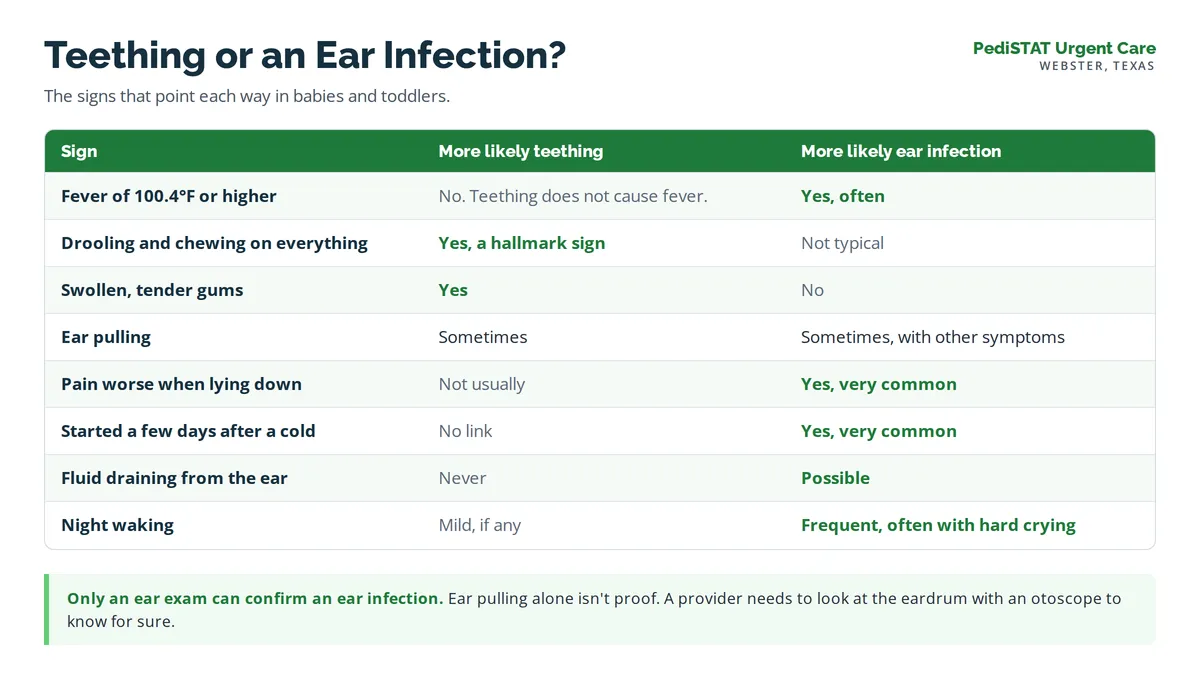
A side by side look at the signs that point to teething and the signs that point to an ear infection.
The bottom line: ear infection or teething is not a guessing game you have to win at home. If there's fever, drainage, or pain that keeps your child up at night, it's time for an ear check. AAP guidance warns that blaming a fever on teething can delay care for a real infection.
If it does turn out to be teething, keep comfort simple and safe. A chilled (not frozen) teething ring or a gentle gum rub with a clean finger works well. Skip numbing gels with benzocaine for kids under 2, homeopathic teething tablets, and amber teething necklaces. The FDA and AAP warn these can cause serious harm, including choking.
Key Clinical Takeaway:
~60% of children with an ear infection are already feeling better within 24 hours, and about 80% of childhood ear infections clear up without antibiotics (Cochrane Review; AAP). An early, accurate diagnosis lets your provider choose the right path for your child: pain control with watchful waiting, or antibiotics right away.
Fever plus ear pain? We can look in that ear today and tell you if it's an infection or a new tooth.
or call (832) 215-8884
When to Seek Immediate Medical Attention
Most ear infections are not emergencies. But some symptoms mean your child should be seen today, and a few mean you should head straight to the emergency room.
Schedule a Same-Day Visit If Your Child Has:
Ear pain with a fever of 100.4°F or higher
Ear pain that lasts more than 24 hours or keeps them up at night
Fluid, pus, or blood draining from the ear
A new fever that starts several days into a cold
Trouble hearing or not responding to sounds after a recent illness
Ear pain that isn't better after 48 to 72 hours of treatment or watchful waiting
A baby between 3 and 6 months old who is fussy, pulling at an ear, and running a fever
Go to the ER or Call 911 If Your Child Has:
Any fever of 100.4°F or higher in a baby younger than 3 months (taken rectally)
Redness, swelling, or tenderness behind the ear, or an ear that seems pushed forward. This can signal mastoiditis, a rare but serious spread of infection into the bone behind the ear.
A stiff neck, severe headache, or unusual sleepiness (hard to wake)
Weakness or drooping on one side of the face
Sudden severe dizziness, confusion, or a seizure
Signs of dehydration: no wet diaper or urine in 8 hours, no tears when crying, or a very dry mouth
A child who looks very sick to you. Trust your instincts.
Not sure which list your child fits? Call us. Our team can help you decide on the right level of care.
What to Expect During Your Clinic Visit & Diagnostic Testing
Knowing what's coming makes the visit easier for you and your child. Here's what happens when you bring your little one to PediSTAT Urgent Care in Webster for an ear check.
Preliminary Physical Assessment
Your visit starts with vital signs: temperature, heart rate, breathing rate, oxygen level, and weight. Weight matters because children's medicines are dosed by weight, not age.
Next, the provider will ask about your child's story. Expect questions like:
When did symptoms start? Did a cold come first?
Has there been a fever? How high, and how was it measured?
Is your child eating, drinking, and making wet diapers?
Any ear drainage, vomiting, or rash?
How many ear infections has your child had in the past 6 to 12 months? Any antibiotics in the last 30 days?
Any medicine allergies, especially to penicillin?
Is your child in daycare? Is anyone at home exposed to tobacco smoke?
A quick note on your phone with fever readings and medicine times is a big help.
The provider then does a full exam, not just the ears. They'll look in the nose and throat, feel the neck for swollen glands, listen to the heart and lungs, and check the skin. Ear infections often travel with other illnesses, like strep throat, pink eye, or a chest infection, so a complete exam matters.
Ear Exam Tools, Rapid Tests & Lab Cultures
Here's something many parents don't expect: there is no swab or blood test for a middle ear infection. The diagnosis is made by looking directly at the eardrum.
Otoscope exam: The provider uses a lighted scope with a small, soft tip to look into the ear canal. A healthy eardrum is thin, pearly gray, and see-through. An infected eardrum is often red, cloudy, and bulging with fluid behind it. The look takes only seconds. For wiggly toddlers, we'll show you a comfy "hug hold" on your lap.
Pneumatic otoscopy: A gentle puff of air checks how well the eardrum moves. A healthy eardrum wiggles. One with fluid behind it barely moves. It doesn't hurt, and it makes the diagnosis more accurate.
Tympanometry: Some providers use a small probe that measures eardrum movement with sound and air pressure. It takes under a minute and helps confirm fluid.
Earwax removal: Sometimes wax blocks the view. The provider may gently clear it first.
Rapid tests for related illnesses: If your child also has a sore throat, cough, or flu-like symptoms, the provider may order a rapid strep, flu, COVID-19, or RSV test using a quick nose or throat swab. With PediSTAT's onsite lab, results are typically ready during your visit.
Ear drainage culture: Rarely needed. If infections keep coming back or don't respond to treatment, the provider may send a sample of ear drainage to the lab to identify the exact germ.
Clinical Consultation & Care Plan
Once the exam is done, your provider will explain what they saw in plain language. You'll learn which ear is affected (or both), whether it's an active infection or leftover fluid, and how severe it looks.
Then you'll make a plan together. Based on AAP guidelines, it usually follows one of these paths:
Antibiotics now: Babies under 6 months are usually treated with antibiotics right away. For children 6 months and older, the AAP recommends them for infection in both ears (ages 6 to 23 months), ear drainage, or severe symptoms: moderate to severe pain, pain lasting 48 hours or more, or a fever of 102.2°F (39°C) or higher.
Watchful waiting: For milder cases in children 6 months and older (one ear only for kids under 2), the AAP supports treating pain for 48 to 72 hours before starting antibiotics, since many ear infections clear on their own. You'll get clear instructions on when to start medicine if symptoms don't improve.
Pain relief for everyone: No matter which path, treating pain is step one.
Before you leave, you'll know the medicine plan, the right dose for your child's weight, what to watch for at home, and when to follow up. Ask every question you have. None are silly.
An ear check takes just seconds. Walk in or book online and leave with a clear answer and a plan.
or call (832) 215-8884
Frequently Asked Questions
Is an ear infection contagious or easily spread?
No. The ear infection itself is not contagious, so you can't catch it from your child. But the cold or flu virus that set it up is contagious. That's why siblings often get sick at the same time, with one ending up with an ear infection while another just gets a runny nose. Handwashing and not sharing cups or utensils help slow the spread.
How quickly do diagnostic test results come back?
Right away. A middle ear infection is diagnosed during the exam itself, so you'll have an answer before you leave the room. If your provider runs a rapid strep, flu, COVID-19, or RSV test, results are usually ready during the same visit. A lab culture of ear drainage is the exception. It's rarely needed and takes a few days.
Can an ear infection clear up on its own without prescription treatment?
Often, yes. The AAP estimates that about 80% of childhood ear infections get better without antibiotics. That's why providers may suggest watchful waiting for mild cases in children over 6 months. But it isn't a do-it-yourself decision. Babies under 6 months are usually treated with antibiotics, and the AAP recommends them for children under 2 with infection in both ears and for kids with high fever or severe pain. Let a provider look first, then decide together.
Does ear pulling always mean an ear infection?
No. A baby pulling ear is common and usually harmless. Babies discover their ears, tug when they're tired, or rub them to self-soothe. Teething pain can also feel like it's coming from the ear. A toddler pulling ear with no fever who is eating, sleeping, and playing normally most likely doesn't have an ear infection. Ear pulling plus fever, a recent cold, night waking, or unusual fussiness is a different story. That combination is worth an exam.
Partnering with Trusted Local Healthcare Providers
When your child is hurting, you want answers fast. You shouldn't have to wait days for a pediatrician appointment or sit for hours in an ER waiting room for an ear check.
That's where PediSTAT comes in. We're a pediatric urgent care in Webster built just for kids and teens. Our providers check ears every day. We'll take a careful look, explain what we see, and give you a plan that fits your child. With an onsite lab and x-ray, we can also check for the illnesses that often travel with ear infections, all in one visit. Families from Webster, Clear Lake, League City, Nassau Bay, Seabrook, and Friendswood count on us for fast, gentle, expert care, seven days a week.
Whether it turns out to be an ear infection or a new tooth, you'll leave with a clear answer and peace of mind.
Contact or Visit PediSTAT Urgent Care Today to receive expert diagnostic testing and personalized ear infection treatment for your family.
PediSTAT Urgent Care
205 E Medical Center Blvd, Webster, TX 77598
Hours
Monday to Friday, 9:00 AM to 8:00 PM
Saturday and Sunday, 10:00 AM to 6:00 PM
Or call (832) 215-8884
Book your visit online
Learn more about our pediatric urgent care services, or come see us for a same-day walk-in visit.
Medically reviewed by Ragini Miryala, MD. Last reviewed: September 23, 2026.
Medical References
American Academy of Pediatrics. The Diagnosis and Management of Acute Otitis Media. Pediatrics. 2013;131(3):e964-e999.
HealthyChildren.org (AAP). Ear Infections in Children: Information for Parents; Teething symptom guide.
National Institute on Deafness and Other Communication Disorders (NIH). Ear Infections in Children.
Venekamp RP, et al. Antibiotics for acute otitis media in children. Cochrane Database of Systematic Reviews. 2023 (CD000219.pub5).
U.S. Food and Drug Administration. Safely Soothing Teething Pain and Sensory Needs in Babies and Older Children.