

What's the Difference Between a Sprain and Strain? A Webster Mom's Guide to Symptoms, X-Rays & Your Child's Visit
By Ragini Miryala, MD, Pediatrician
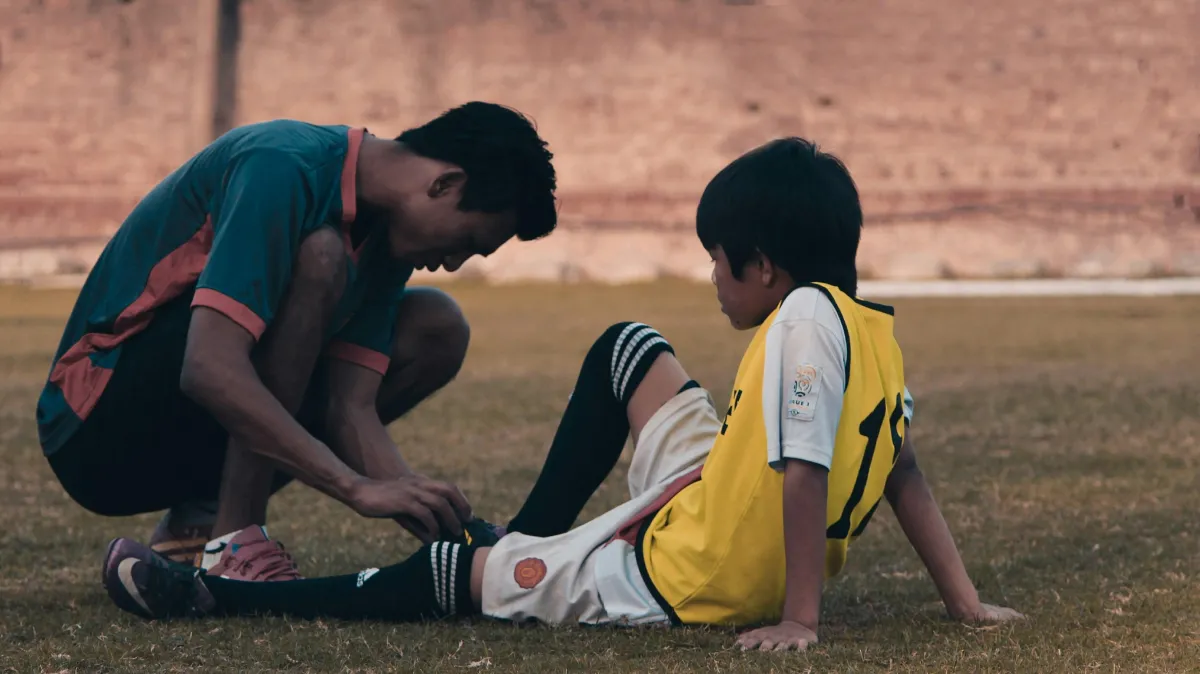
It happens in a split second. A bad landing at volleyball practice. A twist on the soccer field. A tumble off the backyard trampoline. Now your child is holding an ankle or wrist, and you're wondering: is it a sprain, a strain, or something broken? Knowing the difference between sprain and strain injuries, and the signs that point to a fracture, helps you decide what to do next.
Medical Disclaimer:
This content is for educational purposes only and does not constitute formal medical advice, diagnosis, or treatment. Always consult a qualified healthcare provider regarding specific medical conditions.
Here in Webster and across the Clear Lake area, fall sports season keeps kids busy on fields, courts, and tracks. More activity means more twisted ankles, jammed fingers, and pulled muscles. The good news: most of these injuries are minor and heal well with the right care.
But kids are not small adults. Their bones are still growing, and that changes how injuries happen and how they should be checked. A swollen ankle that would be a simple sprain in a grown-up can sometimes be a growth plate injury in a child.
This guide explains how sprains and strains differ, which symptoms need a closer look, and exactly what happens during an injury visit at our clinic, including when your child needs an x-ray.
Key Takeaways
A sprain hurts a ligament. A strain hurts a muscle or tendon. Sprains happen at joints like the ankle, knee, and wrist. Strains usually happen in muscles like the hamstring, calf, or back.
Kids' growing bones need a careful exam. A child's growth plates are weaker than their ligaments, so an injury that looks like a sprain can sometimes be a fracture. A hands-on exam, and sometimes an x-ray, gives you the real answer.
Know your next step. If your child can't take four steps, has pain right on the bone, or isn't improving after 5 to 7 days, schedule a same-day visit. Deformity, numbness, or a cold, pale hand or foot needs emergency care.
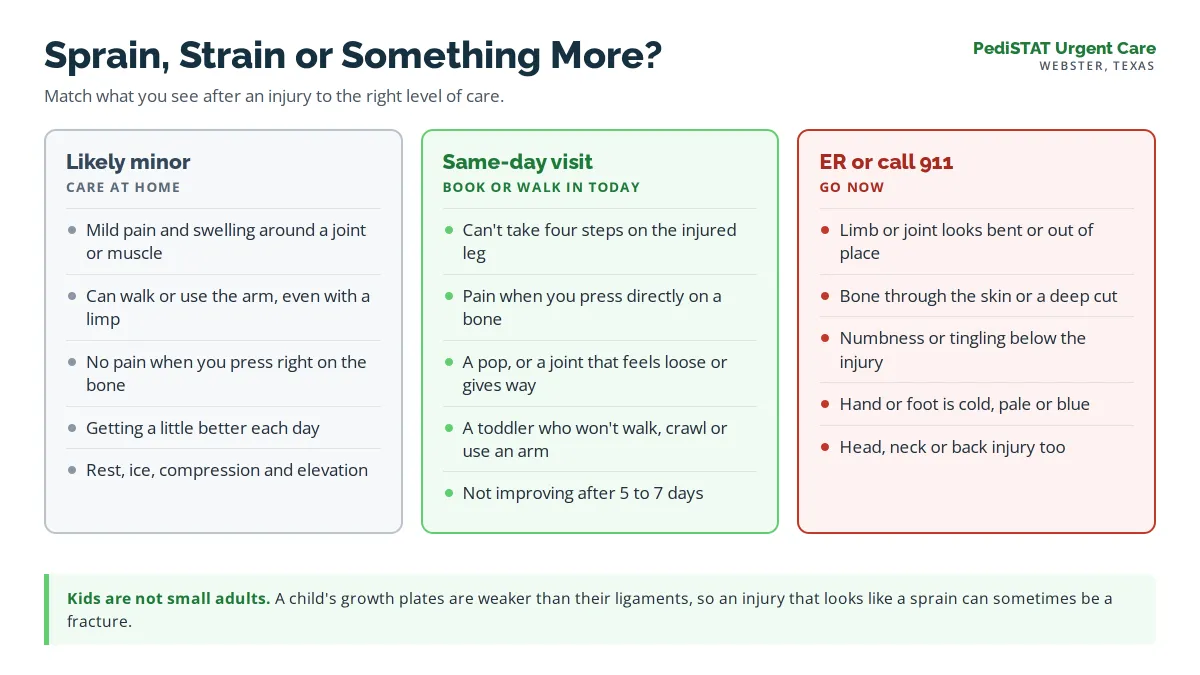
When to care for it at home, when to book a same-day visit, and when to go straight to the ER.
Understanding Minor Sprains and Strains: Causes and Common Symptoms
Your child's joints and muscles are held together by three kinds of tissue:
Ligaments are tough bands that connect bone to bone. They keep joints stable.
Tendons are strong cords that connect muscle to bone.
Muscles create movement by pulling on tendons.
A sprain is a stretch or tear of a ligament. It usually happens when a joint is forced past its normal range, like when a foot rolls inward on an uneven field. The ankle is the most commonly sprained joint in children, but knees, wrists, and thumbs can be sprained too.
A strain is a stretch or tear of a muscle or tendon. It happens when a muscle is overstretched or contracts too hard, too fast. Think of a sprint that ends with a grab at the back of the thigh. Common strain sites include the hamstring, quadriceps, calf, groin, and lower back. Strains can also build slowly from overuse, like weeks of heavy practice without enough rest.
Doctors grade sprains by severity:
Grade 1 (mild): The ligament is stretched with slight fiber damage. The joint stays stable. A grade 1 ankle sprain is the most common kind.
Grade 2 (moderate): The ligament is partly torn. The joint may feel a little loose, and walking hurts.
Grade 3 (severe): The ligament is completely torn. The joint feels unstable, and walking may not be possible.
Why Kids Are Different: Growth Plates
Children have growth plates, areas of softer cartilage near the ends of long bones where new bone forms. According to the American Academy of Orthopaedic Surgeons (AAOS), growth plates are the last part of a child's bones to harden, which makes them especially vulnerable to injury. In many kids, the ligaments are actually stronger than the growth plate. So a twist that would sprain an adult's ankle may injure a child's growth plate instead. Growth plate injuries peak in the teen years and happen about twice as often in boys.
This is why pediatric providers take ankle, knee, and wrist injuries seriously, even when they look minor.
Primary Signs and Symptoms
Sprains and strains share many symptoms. Watch for:
Pain: Usually right away. Sprain pain centers on a joint. Strain pain is usually in the meaty part of a muscle.
Swelling: Often starts within minutes to hours. Sprains tend to swell more around the joint.
Bruising: Common with sprains. It may show up a day or two later and can slide down toward the toes or fingers as it fades. That's normal.
Trouble moving or bearing weight: Your child may limp, refuse to put weight on a foot, or avoid using a hand.
A "pop" at the time of injury: Kids sometimes feel or hear a pop. It can happen with a ligament tear, but it's a reason to get checked.
Muscle spasm or cramping: More typical of strains.
Weakness: Trouble pushing off, gripping, or lifting.
Subtle or Overlooked Indicators
Kids don't always tell you how much it hurts. Some will hide pain so they can stay in the game. Watch for these quieter clues:
Limping that shows up later: Some injuries seem fine at first, then stiffen overnight. A child who wakes up limping deserves a look.
Favoring one side: Carrying a backpack on the "good" shoulder, avoiding stairs, or using the other hand for everything.
A toddler who stops walking or crawling: Young children rarely sprain ligaments. A toddler who suddenly refuses to walk after even a small tumble may have a small crack in the shinbone, often called a toddler's fracture.
A joint that "gives way": If the ankle or knee buckles during normal walking, the ligament may be more injured than it looks.
Night pain: Pain that wakes your child from sleep is not typical of a minor sprain.
Numbness or tingling: Can signal swelling pressing on nerves or a more serious injury.
Sprain vs Strain at a Glance
Feature | Sprain | Strain |
|---|---|---|
Tissue injured | Ligament (bone to bone) | Muscle or tendon (muscle to bone) |
Common spots in kids | Ankle, knee, wrist, thumb | Hamstring, calf, quad, groin, back |
Typical cause | Twist, roll, or fall on a joint | Overstretch, sudden sprint, or overuse |
Where it hurts | Around the joint | In the muscle itself |
Bruising | Common | Less common |
Muscle spasm | Uncommon | Common |
Can look like a fracture? | Yes, especially in kids | Less likely |
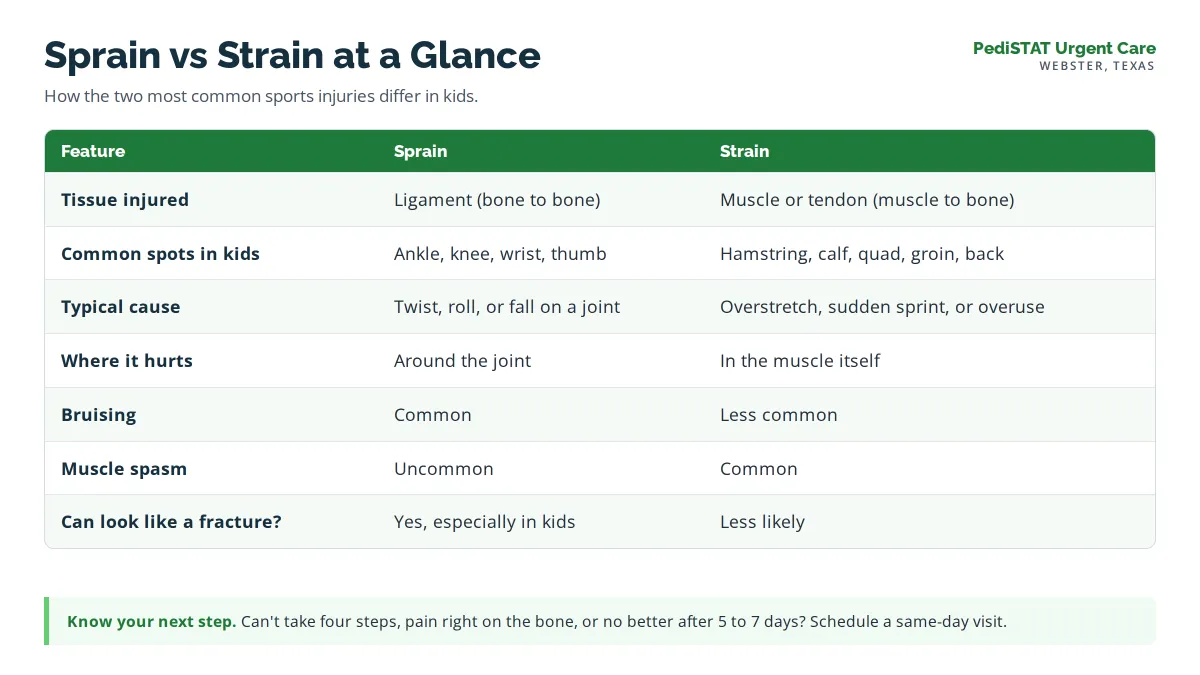
A side by side look at how sprains and strains differ in kids.
Sprained Wrist vs Broken Wrist
Wrist injuries deserve special mention. When kids fall on an outstretched hand, the wrist takes the impact. In children, that often causes a small fracture near the wrist, sometimes called a buckle fracture, rather than a true sprain. The tricky part about sprained wrist vs broken wrist injuries is that both cause pain and swelling, and a child with a broken wrist can often still wiggle their fingers. If there's pain directly over the bone just above the wrist, swelling that doesn't improve in a day or two, or trouble gripping, get it checked.
Key Clinical Takeaway:
~98.5% of ankle and midfoot fractures in children over age 5 are correctly flagged by the Ottawa Ankle Rules, a simple exam checklist providers use to decide who needs an x-ray (Dowling et al., 2009 meta-analysis). A careful exam means your child gets an x-ray when it's truly needed, and skips it when it isn't.
Not sure if it's a sprain or a break? We have x-ray on site and can check it today.
or call (832) 215-8884
When to Seek Immediate Medical Attention
Wondering how to tell if a sprain is serious? Most minor sprains and strains can be managed at home. But some signs mean your child should be seen today, and a few mean you should go straight to the emergency room.
Schedule a Same-Day Visit If Your Child Has:
Trouble taking four steps on the injured leg, right after the injury or later
Pain when you press directly on a bone, especially the back edge or tip of the knobby ankle bones, the bump on the outer edge of the foot near the pinky toe, the bony bump on the top inner side of the midfoot, or just above the wrist
A lot of swelling or bruising, especially in a younger child
A pop at the time of injury, or a joint that feels loose or gives way
Pain that isn't improving after 5 to 7 days of home care
A toddler who won't walk, crawl, or use an arm after a fall
A wrist injury after a fall on an outstretched hand with pain over the bone, or a teen with pain at the base of the thumb
A knee that swells up quickly after a pop
Knee or thigh pain with a limp in a preteen or teen, even without a clear injury. This can come from a hip problem.
Fever, a red or warm joint, or a limp with no clear injury. This is not a sprain and could be a joint or bone infection. Go to the ER if your child looks very sick.
Any swelling or refusal to use an arm or leg in a baby who isn't walking yet
Go to the ER or Call 911 If Your Child Has:
An arm, leg, finger, or joint that looks bent, crooked, or out of place
Bone poking through the skin, or a deep cut over the injury
Numbness, tingling, or "pins and needles" below the injury
A hand or foot that is cold, pale, or blue
Severe pain that doesn't ease with rest, ice, and pain medicine
An injury to the head, neck, or back along with the sprain
Not sure which list fits? Call us. Our team can help you decide on the right level of care.
What to Expect During Your Clinic Visit & Diagnostic Testing
Knowing what's coming helps your child feel calmer. Here's what happens when you bring an injury to PediSTAT Urgent Care in Webster.
Preliminary Physical Assessment
Your visit starts with vital signs and your child's weight, which helps with medicine dosing. Then your provider will ask about the story:
How did the injury happen? Did the foot roll in or out? Was it a fall on a hand?
Did your child hear or feel a pop?
Could they walk or keep playing right after?
What have you tried so far: ice, wrapping, pain medicine?
Any past injuries to the same area?
Next comes a gentle, hands-on exam. Your provider will:
Look for swelling, bruising, and changes in shape
Press carefully along the bones and growth plates to find the exact sore spot
Check movement and strength, comparing the injured side to the healthy side
Test stability of the joint with gentle maneuvers to see if a ligament is loose
Check circulation and feeling in the fingers or toes
Examine the joint above and below, since pain can travel
We go slowly and explain each step. Kids do best when they know what's coming.
Onsite X-Rays & Imaging
Not every sprain needs an x-ray. Providers use proven tools like the Ottawa Ankle Rules to decide. For school-age kids, an x-ray is usually recommended if your child has bone tenderness in key spots or can't take four steps. For toddlers and preschoolers, providers rely more on the exam and have a lower threshold for imaging. Wondering when to get an x ray for sprained ankle injuries? Those are the main signals.
Onsite x-ray: PediSTAT has x-ray on site, so there's no trip to a separate imaging center. The images take just a few minutes.
Multiple views: Your provider usually orders two or three angles of the injured area to get a clear picture.
Growth plate checks: Some growth plate injuries don't show up on x-ray because they pass through cartilage. If your child has tenderness right over a growth plate, your provider may treat it as a possible fracture with a splint or brace and a recheck, even if the x-ray looks normal.
Low radiation: An arm or leg x-ray uses a very small dose of radiation, less than 0.001 mSv. According to RadiologyInfo (ACR and RSNA), that's less than 3 hours of the natural background radiation we all get every day.
Advanced imaging: MRI or ultrasound is rarely needed on day one. If a severe ligament or tendon tear is suspected, your provider may refer you to a pediatric orthopedic or sports medicine specialist.
No lab work needed: Sprains and strains are diagnosed by exam and imaging, not blood tests.
Clinical Consultation & Care Plan
Once the exam and any x-rays are done, your provider will explain what they found in plain language. You'll learn whether it's a sprain, a strain, or a fracture, and how severe it is.
Your care plan may include:
Home care instructions for rest, ice, compression, and elevation
Support, such as an elastic wrap, a brace, a splint, or a walking boot
Crutches if walking is too painful, with a quick lesson on how to use them safely
Pain relief with dosing based on your child's weight
Activity guidance for school, PE, and sports, plus a note if needed
Follow-up timing, and a referral to a specialist if the injury is severe or involves a fracture
Ask every question you have. None are silly.
Exam and x-ray in one visit. Walk in or book online and leave with a clear plan for home, school and sports.
or call (832) 215-8884
Frequently Asked Questions
Are sprains and strains contagious, or can one injury lead to another?
Sprains and strains are not contagious. But one injury can lead to another. A sprain that hasn't fully healed leaves the ligament weaker and balance a little off, which makes it easier to roll the same ankle again. Limping for a long time can also strain other muscles. That's why a full recovery, not just "feeling okay," matters before your child returns to sports.
How quickly do diagnostic test results come back?
Fast. Your provider can see the x-ray images within minutes and review them with you during the same visit. In many urgent care clinics, a radiologist also reviews the images afterward, and you'll get a call if anything new is found. If your child needs an MRI later, that is scheduled separately.
Can a sprain or strain heal on its own without prescription treatment?
Yes, most mild sprains and strains heal with home care alone: rest, ice, compression, elevation, and over-the-counter pain relief. No prescription is usually needed. The key is making sure it really is a minor sprain. Moderate and severe injuries may need a brace, boot, or physical therapy, and fractures need a splint or cast. A quick exam tells you which path you're on.
If my child can still walk or move it, does that mean it's not broken?
No. Many kids with small fractures can still walk, bend their wrist, or wiggle their fingers. Movement alone doesn't rule out a break. Signs of a sprained ankle and signs of a small fracture overlap a lot. Pain directly on the bone, swelling that keeps growing, or pain that isn't improving are all good reasons to have it checked.
Partnering with Trusted Local Healthcare Providers
When your child gets hurt, you want answers without spending hours in an ER waiting room. That's where PediSTAT comes in. We're a pediatric urgent care in Webster built just for kids and teens.
Our providers know how growing bones and joints work. We'll examine your child gently, take x-rays right here on site when they're needed, and give you a clear plan for home care, school, and sports. Families from Webster, Clear Lake, League City, Nassau Bay, Seabrook, and Friendswood count on us for fast, expert injury care, seven days a week.
Whether it's a mild sprain, a pulled muscle, or something that needs a closer look, you'll leave knowing exactly what to do next.
Contact or Visit PediSTAT Urgent Care Today to receive expert diagnostic testing, onsite x-rays, and personalized care for your child's sprain or strain.
PediSTAT Urgent Care
205 E Medical Center Blvd, Webster, TX 77598
Hours
Monday to Friday, 9:00 AM to 8:00 PM
Saturday and Sunday, 10:00 AM to 6:00 PM
Or call (832) 215-8884
Book your visit online
Learn more about our pediatric urgent care services, or come see us for a same-day walk-in visit.
Medically reviewed by Ragini Miryala, MD. Last reviewed: September 23, 2026.
Medical References
American Academy of Orthopaedic Surgeons (OrthoInfo). Sprains, Strains, and Other Soft-Tissue Injuries; Growth Plate Fractures.
Johns Hopkins Medicine. Sprains and Strains in Children.
Nemours KidsHealth. Strains and Sprains: First Aid.
RadiologyInfo.org (ACR and RSNA). Radiation Dose in X-Ray and CT Exams.
Dowling S, et al. Accuracy of Ottawa Ankle Rules to Exclude Fractures of the Ankle and Midfoot in Children: A Meta-analysis. Acad Emerg Med. 2009;16(4):277-287.
Cleveland Clinic. Sprained Ankle.